Sunday, May 29, 2016

A1200 Capacitor Problem (but not the ones you think)


So, a couple of weeks ago I went and got myself a Micronik A1200 tower thanks to ebay (and my superb wife). This tower had an A1200 motherboard in it - it was sold as a working unit after all - but I actually transferred my own A1200 into it.

The reason for this is that my own A1200 was re-capped by me. The soldering standards aren't high but at least the caps are only a year or two old. I don't know the history of this new A1200 board other than it's been in the tower for some time.

Anyway, during the changeover, I noticed something strange. On the opaque plastic sheet under the motherboard (the new one) there was a small, oval hole that shouldn't have been there...

A cigarette burn? A micrometeorite?

Closer inspection revealed that it had been melted by something. A hasty look at the back of the motherboard showed me this:

Aw, crap.

Something bad has happened here. After a look at the A1200 schematics, this capacitor is a de-coupling capacitor for U18 (a RAM chip). Most likely, it has failed, gone short circuit and then pulled a load of current directly from the +5v rail to ground. Release the magic smoke!

One quick order to Element14 for a strip of new caps and we're off on the next repair. :)

Here's a close up of the problem. From this it should be obvious that one end of the cap is likely to have damaged the solder pad on the board. It needs to come off.


It doesn't look any better close up.
As this next picture shows, the pad WAS destroyed. In fact, as soon as I touched the cap with the soldering iron, it basically fell off the board. The picture shows the scene after a cleanup.

Wherefore art thou solder pad?

Here's the offender in all his 1206 glory (1206 means 12 thousandths of an inch long by 06 thousandths of an inch wide in case you're wondering how flippin small these things are).

Ah. There's my pad. Tell you what, you keep it...

I don't have the tools, time or patience to carry out a proper repair. I'd need copper sheet, suitably rated epoxy for under-bonding, appropriate conformal coating etc etc which is all stuff I don't have. So here's my solution:

Nailed it.

The replacement cap was soldered to the good pad and a small jumper wire (about 4mm long) was soldered between the end of the good cap at C18B and the end of the replacement cap at C18A. So far, everything seems OK. I have the A1200 playing the demo for Elite II over and over to give it a bit of a workout and it all seems OK.

Tomorrow I shall take it all apart again and check to make sure it has not repeated.


Thursday, May 19, 2016

A500+ Update - A Bit Disappointing....

Depending on your point of view, this update on my broken A500+ is a bit disappointing.

I dismantled my own A500+ so I could pinch the floppy drive and keyboard for some more rigorous testing. I noticed straight away that my own A500+ has a very different motherboard to the broken one. Well, I say different. They are actually different colours. Have a look:


My original A500+ is very green

This one is very brown(ish) - note the missing trapdoor connector
There's no difference in the components, just the colour of the actual PCB. Strange. 

Anyway, after connecting up the floppy and keyboard I turned the broken board on and....


...it worked. Perfectly. Everything I threw at it it just worked. This is outrageous. I demand a more damaged motherboard that takes me longer than half an hour to fix. 

Pictures to prove that the Amiga is a hardy beast:

Running a test program

Running OctaMED on a super untidy desk...
So that's it. It just works. Anyone need a fully working A500+ motherboard?

Wednesday, May 18, 2016

Death by Rechargeable Battery

Any Amiga afficiandos amongst you will know that, back in the day, Commodore had some funny ideas when it came to upgrading the Amiga. First, the A500 came out with Kickstart 1.2 which was upgraded some time later to Kickstart 1.3. This was the de-facto Amiga A500 for a good number of years.

Then, in 1991, like all good buses, two upgrades (well one upgrade and a cancellation really) came in quick succession. First, the A500 had a boost to the A500+. It came with a whole 1Mb of RAM and the shiny new Kickstart 2.04 which was similar to the big brother A3000s ROM. Very soon after, for some bizarre upper management reason (i.e. complete incompetence) the A500 was scrapped and replaced with the A600.

I won't debate the merits of the A600 (or A300 as it SHOULD have been - I seem to recall the manager responsible for the A600 was fired) but instead focus on the A500+. This machine holds a special place for me since it was my first Amiga. I had an early A500+ and the white box it had said 'A500' (no 'plus') in the Cartoon Classics pack so I had no idea it was a A500+ until I actually took it out of the box.

One additional feature of the A500+ was the built in real time clock. This may seem quite quaint these days but back then, this was the height of 'ooooh!'. To power the clock a small battery was factory fitted to the motherboard. For the market life of the machine there were no problems and we all enjoyed having accurate dates and times on our files.

Fast forward 25 years.

Retro computing is gaining in popularity. Amiga computers are popular with collectors and retro gamers as they're pretty reliable and, well, cool. But there's a problem. Remember that little barrel battery on the motherboards of the A500+? Well, what do you think batteries do if they're left for years with no use, no voltage, no current and no charging? They leak. What do batteries contain? I will give you a clue. They do not contain rainbows and unicorns. They contain liquid death.

The story normally goes something like this. You see some article on how retro gaming is popular. Prices for systems are rising. Hmmm. You used to have an Amiga. Maybe it's in the loft/garage/shed? You dig it out. Yes, an Amiga A500+. You plug it in. You turn it on to see if it still works. Green screen. Or black screen. Or slowly flashing power LED. At this point a lot of people might throw it in the bin (NO DON'T!) or pop it on the table at a car boot sale for a couple of quid. The braver souls might open the case and peer inside. They might see something like this:

What's that green stuff?

More green stuff..

That green stuff is corrosion caused by the battery spewing its contents all over the motherboard. The first thing is to remove the battery then cover the affected parts of the board in lemon juice (really). It neutralises the corrosion and fizzes nicely while doing it. Then, wash the area with isopropyl alcohol and leave to dry. Sometimes the board has been lucky and the damage is limited. Sometimes it's too late. :(

Just to be clear, the batteries in these things have a life of up to about 6 or 7 years if you're lucky so there is no blame here. These things are now 25 years old. It's just a fact of life if you have an Amiga A500+ (or 4000 or 2000 actually).

The point of all this is that I took a gamble on a cheap A500+ motherboard from ebay. The seller said that it didn't work as the battery had leaked. Looking at the photos the damage didn't look too bad - not that you should trust the photos. So, a few days ago I received a package.


Newspapertastic
After cautiously unwrapping it, I found this:

Shielding included (didn't realise it was!)

The Patient
First things first. Let's check what the damage really looks like. At first glance, it's actually not too bad. Someone has attempted to clean up the board and the battery has been removed. The damage is still obvious though. 

Corrosion everywhere :(
Next, lets plug this baby in. The screen turns white then almost instantly shows solid green. That's not good. It means that there's a problem with the chip RAM but could mean that it's the RAM that's faulty or any of the components between the RAM, CPU, ROM and custom chips... This will take a bit of work. 

OK, so now we inspect the board a lot more closely. I cleaned off as much of the green corrosion as I could, partly by scraping with a scalpel and partly by using isopropyl alcohol. Not as good as lemon juice but it did the job for what I needed. Next, a lot closer look at the tracks that are in the firing line:


There's one definite break (possibly more)

Close up of 4th pad down on top picture - definitely unhappy


A clean break - no copper left here at all

By using the continuity function on a multimeter I confirmed that there were two traces that definitely had problems. These were from the 'south' end of R101 to the via and from the 'south' end of R112 to the via. As it turns out, there was a third issue from the 'south' side of E102, as it runs past the leg of the EVIL KILLER FROM HELL - er I mean battery. 

For the resistor R101, I could not find where the break was. It was most likely that the trace had multiple tiny breaks, making it impossible to just use a sliver of wire as a track repair. In the end, I installed a jumper from R101 to the via. 

For the resistor R112, things were a bit more straightforward. I used a stripped piece of 30awg wrapping wire, about 6mm long and bent into the right shape to bridge the gap from the track to the via.

Finally, I used a straight piece of the same wire, again about 6mm long, to repair the straight trace that had been damaged next to the battery leg.

The results look like this:

Wire added from broken track to via - jumper visible back to R101

Connection to R101 - not the neatest but it's connected now

Track repair next to the battery leg (battery removed)

Before I could test it I realised that the trapdoor connector had suffered badly too at the hands of the evil battery. The pins had corroded badly and there was nothing I could do to save them. I had to remove the entire connector. :(  Fortunately, they are available new. Yay! :)

Connector still attached but looking poorly...

Connector partly removed - not looking any better

Pins cleaned up to illustrate the damage batteries can cause
So, with all this done, time to plug it in and see if there is any improvement. Why, yes, Yes there is. :) 

Another A500+ saved from the bin

There is still a lot to do on this but the worst of the problems are out of the way. Stuff that needs doing:
  • Test the whole thing
    • Floppy drive
    • Sound
    • Keyboard
    • All ports
  • Replace the trapdoor connector
  • Buy a case, keyboard and floppy...(remember I only bought a faulty motherboard!)
I will update you all soon once I've carried out more tests, but so far, it's looking good.


Monday, April 18, 2016

Amiga Audio Issues - Part 3


So, the MC1488 chips have arrived. The one in the A500 is actually an MC1488N made by Texas Instruments whereas the ones I have here are MC1488P made by Motorola. There is no difference in the chips at all. In fact, my A500+ actually has an MC1488P.

MC1488P x 5

Having done a lot more reading I understand what the MC1488 is doing in this context. It is normally used in changing TTL voltages to RS232 voltages for serial communications. They contain four 'drivers', a driver being the conversion from TTL voltages to RS232. The MC1489 chip which sits above the MC1488 on the motherboard contains four 'receivers', which convert RS232 back to TTL voltages. In this particular instance, the first input appears is being used as a 'NOT' gate to change the 0v to 5(ish)v from the CIA into a more meaty +12v to -9v.

I won't go into any more detail, partly because it could become very technical but mostly because I don't fully understand it all. Suffice it to say that when the MC1488 has 0v on pin 2 there should be 12v on pin 3 and when there's 5v on pin 2 there should be -9v on pin 3. Given that my MC1488 has 12v - or thereabouts - on pin 3 no matter what the voltage on pin 2, this leads me to believe that there is an open circuit in the chip, hence, replace the chip. :)

So, tops off again chaps...

Unfortunately my phone camera failed miserably and didn't take pictures of the process of me getting the chip off the board. :(  Basically, it involved cutting through the legs on one side of the chip - carefully - then bending up the chip to make it easier to do the same to the other side. A few minutes later, with the help of some solder wick and a pair of good quality tweezers and the chip and it's legs are gone.

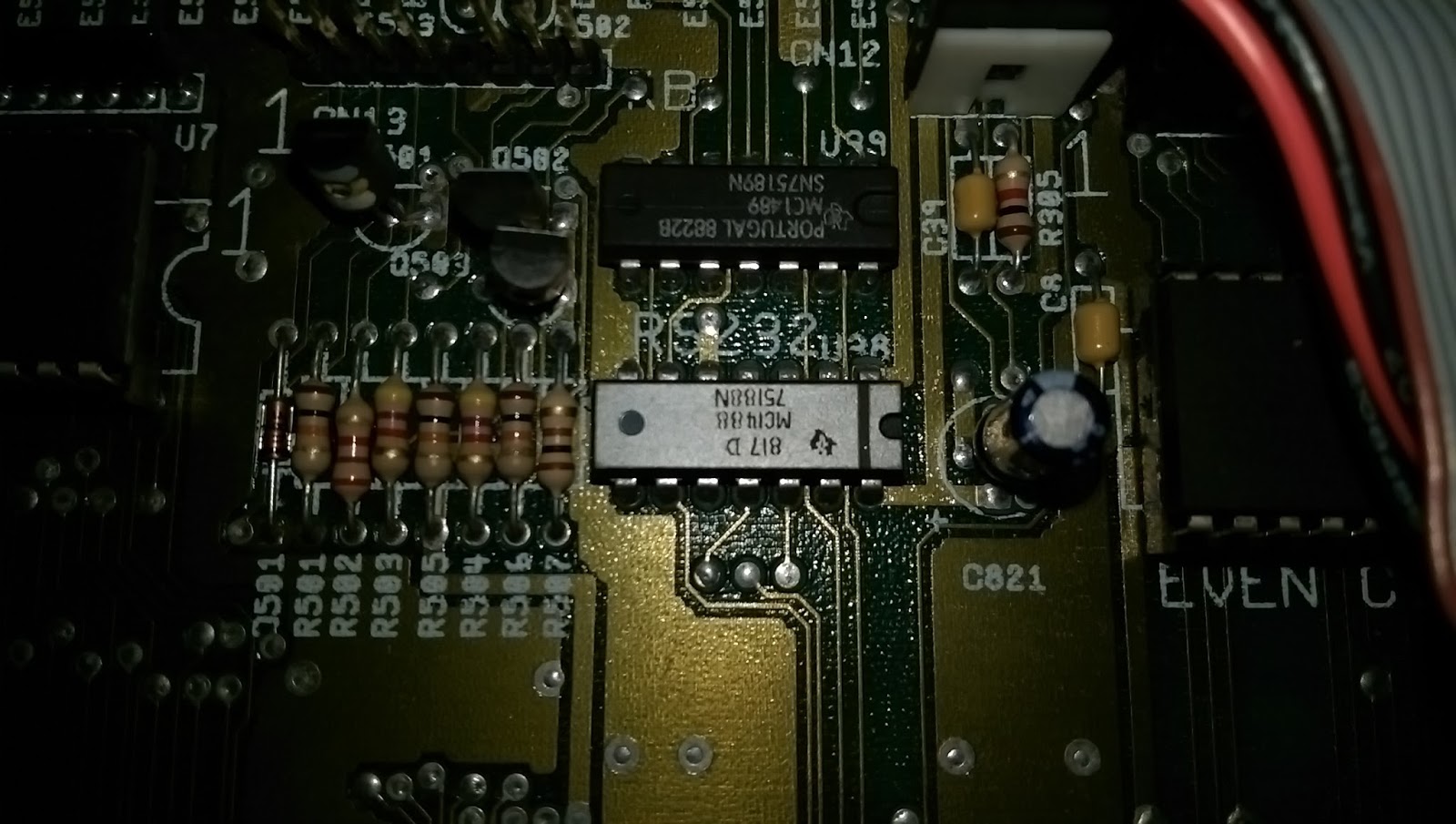
The dead MC1488 RS232 line driver chip

This chip was silver for some reason. It's the only time I've seen one like this. In my A500+ it's black and all of the pictures of the various A500 motherboards on the Big Book of Amiga Hardware website show it as black too. Maybe it was special? Either way, it's dead.

Awaiting pin removal

I cleaned the old solder off with solder wick and then cleaned the surface with isopropyl alcohol with some cotton buds. Finally, I used a bit more alcohol and an old toothbrush to make sure no debris or other junk was left nearby.

New MC1488P installed and ready for action

Once the chip was inserted it was a two minute job to solder the fourteen pins. Far easier than Agnus.. Once again, when I'd finished I cleaned the board with some isopropyl alcohol and cotton buds, followed by a final scrub with the toothbrush.

Let's get this sucker tested!

I plugged in the floppy drive, power cable, monochrome composite output (who wants to mess with an A520 at this point? Not me.) and audio out left and right to my PC speakers. The A500 booted without any problem but then guru'ed when I tried to run OctaMED. Like a numpty I had forgotten to put the 512kb expansion in too. OctaMED won't run in 512kb...

Testing - this time with 1Mb.
Take 2.

It worked flawlessly. The difference in sound is now quite distinct with a definite treble and white noise that wasn't there before. Switching the filter on restores the 'muffled' sound, just as intended. Another repair successfully completed. :)

Success! The filter is working!


Thursday, April 14, 2016

Amiga Audio Issues - Part 2 - A Diversion

So, while I was trying to diagnose the issue with the MC1488 I managed to drop the multimeter probes just before I finished and shorted something. The Amiga froze. No big deal. Just restart it. But it didn't restart, instead I was left looking at a dark grey screen.

Dodgy MC1488 Chip (the silver one)

Ah - Dark Grey Screen on Bootup
Don't panic! Stay calm!

No worries. Just pop the top off again, press all the chips into place (the ROM and Agnus made satisfying creaking noises - normally an indication that they're not in properly) and try again. This was the result:


ARRGHHH!!! PANIC!!! ARGHHHHH! I've killed it!!

After a stiff drink and a lie down I came back to it and tried to reason things out. The screen, although rolling, is definitely green. This normally indicates an issue with the chip RAM. That was, however, a bit unlikely since I had been nowhere near that part of the board and it would be a big coincidence that a RAM chip died at that very moment. But I had read somewhere that problems with Agnus could also, in some situations, cause a similar fault.

With a spare Agnus I managed to improve things slightly. But only slightly since I now had a solid bright green screen or random coloured pixels.

Our situation has not improved...
Maybe it was the chip RAM at fault. I had a RAM chip of the same type in my box so I placed it over each existing chip and turned on the Amiga to see if the green screen would go away. Sadly this made no difference.

Appeals to the Amiga group on Facebook (hi guys!) resulted in many suggestions but the one that kept cropping up was to re-seat Agnus. But there was no point since Agnus was as far into the socket as I could push her....(can you see where this is going?)

Out of curiosity, I removed Agnus and then pushed the chip into the socket but only just so the top of the chip was proud of the socket. Sure enough, the Amiga burst back into life. The socket was borked.

In this case, ebay is you friend. Four new sockets delivered for a couple of quid.


Cue montage of me sweating over a steaming motherboard, wiping my brow, looking at schematics, reaching for tools, slurping tea etc. Pictures of my removing the socket are not included to protect the sensitive..

Socket Removed
New Socket Inserted 
Chips Re-installed
If you have a go at this type of repair, and if I can do it then anyone can, here's a couple of tips. Firstly, get yourself some de-soldering braid and a de-solder pump. I had the braid but not the pump so to get the old solder out of the holes for the socket I had to use a pin. Using the soldering iron I melted the solder and pushed the pin through the hole. The solder got dragged through the hole by the pin then cooled down, to be removed with a quick wipe of the iron. 84 times. Get yourself a de-soldering pump. Do it. NOW.

With a new socket, both of the Agnus chips I have now work without any issues so this socket repair is done. :)

Repaired and fully operational.


Friday, April 08, 2016

Amiga Audio Issues

A little while ago I bought an Amiga A500. After having lots of fun cleaning it up and putting in a new ROM (Kickstart 2.04) I tested it thoroughly by playing...er...I mean running the demo of Frontier Elite II. I also played lots of music through OctaMED.

It was during the music that I noticed something a bit off. The audio sounded OK but was a bit muffled. It then occurred to me that the Amiga's audio filter was switched on. But according to OctaMED it wasn't.

For the uninitiated, the Amiga has a hardware low pass audio filter built in which can be controlled by software. It was, allegedly, included by Commodore to improve the sound of sampled audio which was quite low quality (compared to today - in those days it was awesome!). Basically, if you turn the filter on it effectively hides some of the artefacts or 'graininess' of the sampled sounds. In most uses it's turned off and this is indicated by the Amiga by dimming the power led a bit.

So, in OctaMED I tried turning the filter on and off an noticed that it made no difference to the sound of the audio, even though the LED dimmed like it should. Fortunately, RetroGameModz on youtube has a whole 50 minute video on troubleshooting the audio filter. It's worth a look if you are into your Amiga hardware (probably give it a miss if not..). Find it here. Time to get that top off..


Amiga Audio Testing Studio - also known as my desk.

To cut a long story short I followed the advice given in the video and found that the chip U38 looks like it's having 'issues'. When the filter is on then the voltage at pin 2 of the chip should be around 0 volts and at pin 3 should be about 12 volts. This is pretty much what I get give or take a tenth of a volt.  With the filter off the voltage at pin 2 should be near 5 volts and the voltage at pin 3 should be -9 volts or so. In my case though, the voltage at pin 2 is about 6 volts but at pin 3 there is still 12 volts (11.85 to be precise). This is, as they say, a bit of a problem.

Voltage at U38 Pin 2 - Filter On
Voltage at U38 Pin 2 - Filter Off

Voltage at U38 Pin 3 - Filter On (Correct)
Voltage at U38 Pin 3 - Filter Off (Argh! Incorrect. Should be -9v)
I don't pretend to fully understand the circuit but, in simple terms, by having 12 volts from pin 3 of U38 then the transistor Q301 has 12v at the base and at the emitter, meaning that the transistor is off. Because of this, the other side of the circuit has -12v since there is nothing to pull up the voltage. This results in -7v (ish) at the gates of two JFETs resulting both JFETs being 'cut-off' so current is forced to take the path through the low pass filter.

Audio Filter Schematic (part)

I've also tested this on a known working A500 (it's an A500+ actually but the circuit is the same) and the voltage results I get from this more closely match those on the YouTube video since the MC1488 chip is behaving as it should.

So. Is it worth replacing the chip? Probably. They're about 40p from Farnell so it's not like they are obsolete or difficult to get like the A1200 video DAC for example. The only danger is that I damage the board as I try to remove the chip, bearing in mind that these boards are over 25 years old. This particular motherboard is marked as being made in 1989 so he's actually 27!

Old

I do have a concern that the switching voltage at pin 2 of U38 seems a bit high at 6v. I traced it back to the CIA and it all seems OK.

CIA (Odd) - _LED Comes from Pin 3

I suppose it could just be a variation of the components and the different motherboard designs or even possibly a symptom of the faulty MC1488  - although it is a simple single input device. I have a few spare CIAs so I might put one of those in just to verify that the voltage is the same no matter what. Looks like an order to Farnell is also on the cards.

To be continued...